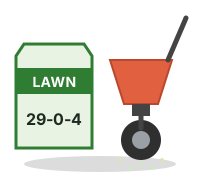
How the lawn fertilizer calculator works
The calculator adds up the area of your lawn zones and subtracts any cut-outs. It divides your target rate, in pounds of nutrient per 1,000 sq ft, by the nutrient percentage on the bag to get pounds of product per 1,000 sq ft, then scales that up to your whole lawn. It also shows what that application puts down in N, P₂O₅ and K₂O, how many bags you need, how far one bag goes, and the cost per pound of nutrient.
Total product = product per 1,000 sq ft × (lawn sq ft ÷ 1,000)
Bags = total product ÷ bag weight, rounded up
Area one bag covers = bag weight ÷ product per 1,000 sq ft × 1,000
Area formulas used for each shape
| Shape | Formula |
|---|---|
| Rectangle | length × width |
| Circle | π × (diameter ÷ 2)² |
| Triangle | ½ × base × height |
| Known area | entered directly in sq ft (or sq m if you chose meters) |
Worked examples
Example 1: a 5,000 sq ft lawn, 22-0-4, 1 lb of nitrogen
1 ÷ 0.22 = 4.5 lb of fertilizer per 1,000 sq ft. For 5,000 sq ft that is 4.5 × 5 = 22.7 lb. One 50 lb bag is enough, with about 27 lb left. One bag covers about 11,000 sq ft at this rate.
Example 2: a 10,000 sq ft lawn, 29-0-4, 1 lb of nitrogen
1 ÷ 0.29 = 3.45 lb per 1,000 sq ft. For 10,000 sq ft that is 34.5 lb, which fits in one 40 lb bag with about 5.5 lb spare. The same pass also puts down about 0.14 lb of potash per 1,000 sq ft.
Example 3: one acre with urea (46-0-0), a light 0.5 lb of nitrogen
0.5 ÷ 0.46 = 1.09 lb per 1,000 sq ft. One acre is 43,560 sq ft, so you need 1.09 × 43.56 = 47.4 lb, which is one 50 lb bag. Urea is quick-release, so keep it at or under 1 lb of nitrogen per application.
What the numbers on the bag mean
| Number | Nutrient | What it does for grass |
|---|---|---|
| First (N) | Nitrogen | Green color and leaf growth. The main lawn nutrient |
| Second (P₂O₅) | Phosphate | Root growth. Often not needed on an established lawn |
| Third (K₂O) | Potash | Stress tolerance, such as heat, cold and drought |
Always listed in that order, as a percentage of the bag's weight. A 24-0-6 bag is 24% nitrogen, no phosphate and 6% potash.
When to fertilize
| Grass type | Best times | Notes |
|---|---|---|
| Cool-season (fescue, bluegrass, ryegrass) | Early fall most of all, late fall, and spring | Go lighter in summer heat |
| Warm-season (Bermuda, zoysia, St. Augustine, centipede) | After green-up in late spring, then through summer | Do not feed in dormancy |
These are general guides. Needs vary by grass variety, soil and climate, so ask your state's extension service for a local schedule.
Mistakes to avoid
- Using the bag's weight instead of its nitrogen. A 50 lb bag of 22-0-4 holds 11 lb of nitrogen, not 50. Always work from the nitrogen percentage.
- Putting down too much quick-release nitrogen. More than about 1 lb of nitrogen per 1,000 sq ft in one go can burn the lawn. Split heavier feeding into two passes or use slow-release.
- Skipping the soil test. A soil test tells you whether you need phosphorus or potash at all. Many established lawns only need nitrogen.
- Not calibrating the spreader. Settings on the bag are a starting point. Weigh what a test strip puts down and adjust.
- Leaving granules on the driveway. Sweep spills back onto the lawn so fertilizer does not wash into storm drains.
How far does a bag of fertilizer go?
Coverage depends on the nitrogen percentage and the rate you apply. This table shows pounds of product per 1,000 square feet and how far a 50 lb bag goes at 1 lb and at 0.5 lb of nitrogen per 1,000 square feet.
| Analysis (N-P-K) | Product per 1,000 sq ft at 1 lb N | 50 lb bag covers at 1 lb N | 50 lb bag covers at 0.5 lb N |
|---|---|---|---|
| 46-0-0 | 2.2 lb | 23,000 sq ft | 46,000 sq ft |
| 32-0-4 | 3.1 lb | 16,000 sq ft | 32,000 sq ft |
| 29-0-4 | 3.4 lb | 14,500 sq ft | 29,000 sq ft |
| 24-0-6 | 4.2 lb | 12,000 sq ft | 24,000 sq ft |
| 22-0-4 | 4.5 lb | 11,000 sq ft | 22,000 sq ft |
| 21-0-0 | 4.8 lb | 10,500 sq ft | 21,000 sq ft |
| 18-24-12 | 5.6 lb | 9,000 sq ft | 18,000 sq ft |
| 10-10-10 | 10.0 lb | 5,000 sq ft | 10,000 sq ft |
These cover the nitrogen target only. Check the label of your own product for its spreader setting and maximum rate.
Frequently asked questions
How much fertilizer do I need for my lawn?
Divide the pounds of nitrogen you want per 1,000 square feet by the nitrogen percentage on the bag, then multiply by your lawn size in thousands of square feet. For 1 lb of nitrogen with a 22-0-4 fertilizer that is 1 ÷ 0.22 = 4.5 lb per 1,000 sq ft, or 22.7 lb for a 5,000 sq ft lawn.
How much fertilizer do I need for a 10,000 square foot lawn?
At 1 lb of nitrogen per 1,000 sq ft, a 29-0-4 fertilizer needs about 3.45 lb per 1,000 sq ft, so about 34.5 lb in total, which is one 40 lb bag. A 22-0-4 fertilizer needs about 45.5 lb, so one 50 lb bag. Divide 100 by the nitrogen percentage and multiply by 10 for a quick check.
How many square feet will a 50 lb bag of fertilizer cover?
It depends on the nitrogen percentage and your rate. At 1 lb of nitrogen per 1,000 sq ft, a 50 lb bag of 29-0-4 covers about 14,500 sq ft, a bag of 22-0-4 covers about 11,000 sq ft, and a bag of 10-10-10 covers about 5,000 sq ft. The label's coverage is usually based on its own rate.
How many bags of fertilizer do I need for 1 acre?
An acre is 43,560 square feet. At 1 lb of nitrogen per 1,000 sq ft you need 43.56 lb of nitrogen. With a 29-0-4 fertilizer that is about 150 lb, or four 40 lb bags. With a 22-0-4 fertilizer it is about 198 lb, or four 50 lb bags.
How much fertilizer per 1,000 square feet?
Most lawn products are applied to deliver about 0.5 to 1 lb of nitrogen per 1,000 sq ft per application. The pounds of product depend on the bag: about 2.2 lb of 46-0-0, 3.4 lb of 29-0-4 or 4.5 lb of 22-0-4 per 1,000 sq ft for 1 lb of nitrogen. Always follow the label.
What do the three numbers on a fertilizer bag mean?
They are the percentages by weight of nitrogen (N), phosphate (P₂O₅) and potash (K₂O), always in that order. A 50 lb bag of 24-0-6 holds 12 lb of nitrogen, no phosphate and 3 lb of potash.
How much starter fertilizer do I use per 1,000 sq ft?
Follow the rate and spreader setting on your starter product, because analyses differ. Starter fertilizers are higher in phosphorus, and many states limit phosphorus, so a soil test or new seeding is the usual reason to use one. The calculator can target phosphate if you want to work out a rate.
How often should I fertilize my lawn?
Many lawns are fed two to four times a year, with a total of about 2 to 4 lb of nitrogen per 1,000 sq ft. Cool-season grasses are fed most in early fall, and warm-season grasses are fed after green-up in late spring and summer. Your state extension service can give a plan for your grass.
Can I put too much fertilizer on my lawn?
Yes. Too much quick-release nitrogen can burn the grass, and extra fertilizer can wash into drains and streams. Stay at or below 1 lb of quick-release nitrogen per 1,000 sq ft per application, sweep spills off hard surfaces, and water granules in.
How much should I charge to fertilize a 12,000 square foot lawn?
Charge for your material plus your time. At 1 lb of nitrogen per 1,000 sq ft, a 12,000 sq ft lawn needs about 41 lb of a 29-0-4 fertilizer. Enter your bag price in the calculator for the material cost, then add labor, travel and a margin. Local rates vary, so check what nearby lawn companies charge.
 Sod calculatorPallets, slabs and rolls for a new lawn
 Compost calculatorTop-dress a lawn or beds